Launching a clinic into search: how a men's health brand new to the UK reached 311K impressions and 67 AI citations.
Pulse Digital Health built the digital presence for Gentle Procedures UK before the doors opened, then grew it through launch and the first trading months. In 9 months the site went from no recorded search footprint to 310,501 impressions, 4,347 clicks and 67 citations across ChatGPT, Gemini, AI Overviews and AI Mode.
01 . Client overview
The client
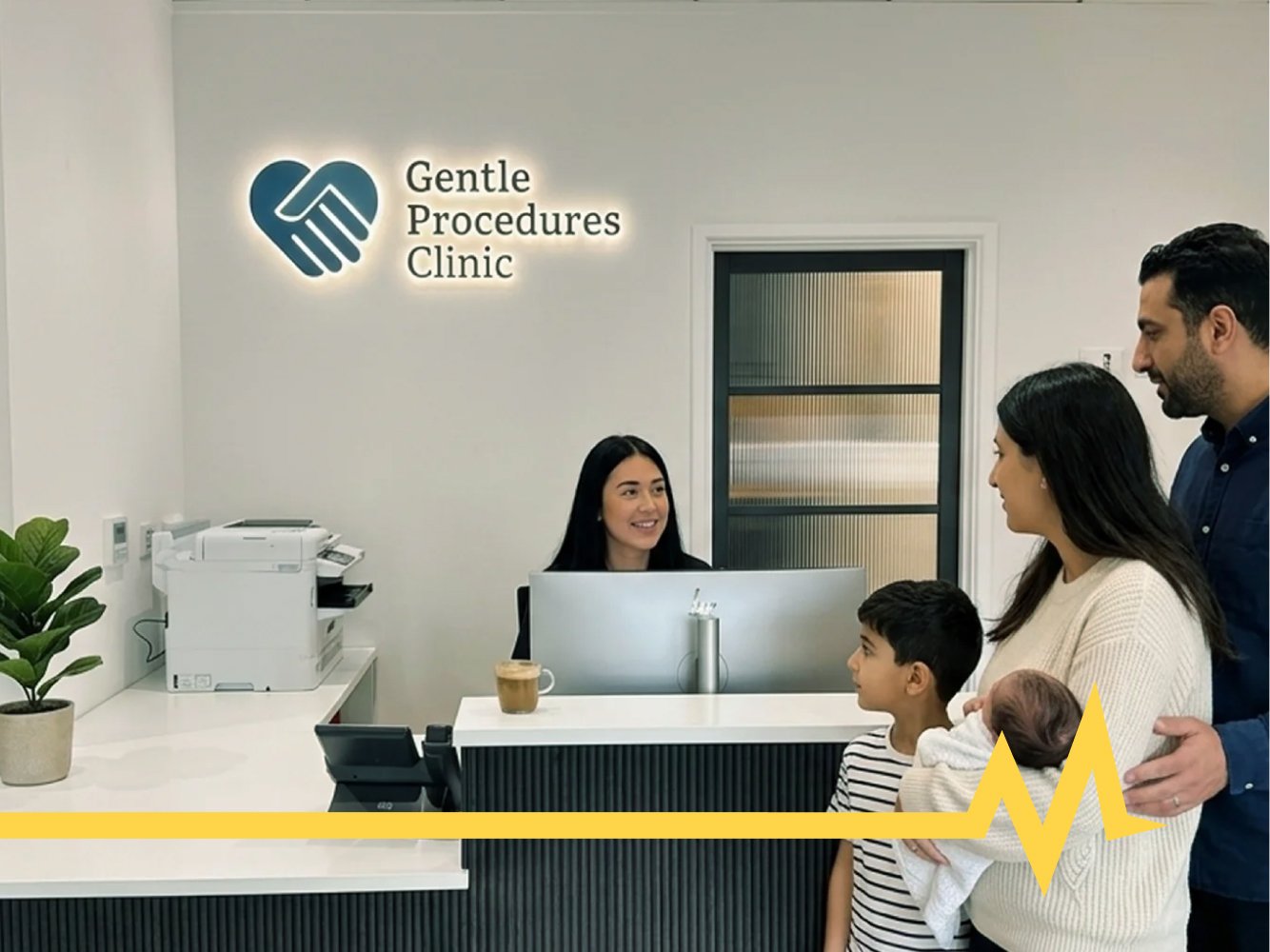
Gentle Procedures UK is a CQC-registered, doctor-led private clinic for men's procedures, operating under an international franchise model that had no presence in the UK market. The first clinic opened at Birmingham Business Park, with further sites planned across the Midlands and beyond.
The clinical offer covers vasectomy, including the no-scalpel and no-needle approach, circumcision from newborn through to adult, frenulectomy, frenuloplasty, preputioplasty, phimosis treatment and men's health assessments, delivered by GMC-registered doctors.
Pulse Digital Health was appointed before the clinic opened. There was no website traffic, no reviews, no UK brand recognition and no search history to build on.
Sector
Private men's health. A category with high search demand and low willingness to discuss it, where trust has to be earned entirely online before a patient ever picks up the phone.
Starting position
No indexed service estate, no ranking keywords and no brand demand. Google Search Console records no impressions at all until the new service pages began to index.
Remit
Build the digital presence pre-launch, then make it findable across Google, Google Maps and AI search, while holding every claim to ASA, CAP and GMC standards.
02 . The challenge
The challenge
Four problems had to be solved at once, and none of them could wait until after opening day.
Zero market presence
The franchise reputation counted for nothing in Birmingham search results. Visibility had to be built page by page against established local providers, five of whom already competed on the same keyword set.
A sensitive category
Vasectomy and circumcision are searched constantly and discussed rarely. Content had to answer anxious, specific questions plainly, including for Jewish and Muslim families and for parents of newborns.
Compliance under pressure
Every page is YMYL content in a regulated sector. No superlatives, no absolute safety claims, no unverified operational promises, and clinical sign-off routed through named doctors before publication.
AI answers, not just blue links
Patients increasingly ask ChatGPT and Gemini which clinic to use. Being invisible to those systems at launch would have meant losing the recommendation before the search result even loaded.
Launch-day urgency
The clinic opened with low patient volume and needed enquiries in week one, not month six. Organic, local and paid all had to be live and working from the start.
Built to expand from day one
One clinic open, more already planned. The site had to be structured so that new locations could be added without rebuilding the architecture, splitting the local footprint or duplicating content across sites.
03 . Our strategy
Our strategy
We ran five strands in parallel rather than in sequence, so the service estate, the content engine and the local footprint all matured together and compounded.
Build the estate before the doors opened
We architected the site around procedures rather than around the business: separate hubs for vasectomy, circumcision and specialist men's health, each with its own child pages for costs, methods, recovery and aftercare. Area pages for Birmingham, Solihull and the wider West Midlands sat alongside them, structured so that further clinic locations could slot in without reworking the hierarchy, with booking pop-ups, downloadable aftercare guides and WhatsApp contact built in. The estate grew to 261 pages earning impressions in Google.
Answer the questions patients will not ask out loud
The content programme was mapped to real patient anxiety rather than to keyword volume alone: what a poor circumcision result looks like, how to sleep after the procedure, recovery timelines, whether a vasectomy can fail, NHS versus private routes and what each option costs. Faith-based guidance for Jewish and Muslim families sat alongside newborn aftercare. Every article carried a named clinician byline and went through five review passes covering readability, empathy, house style, ASA and CAP compliance and pre-publish checks.
Make the site legible to machines
MedicalWebPage and FAQPage schema was deployed page by page, with the doctors typed as both Person and Physician and the organisation marked up as a MedicalOrganization, so the entity graph tied clinicians, clinic and procedures together. Alongside it ran a full technical programme: redirect and 404 remediation, indexing management, meta titles and descriptions across the estate, an image and alt text audit, internal link builds into the money pages and a mobile speed programme.
Win the local pack, then the region
Google Business Profile optimisation, a review generation routine and consistent naming across every listing gave the Birmingham clinic a local footprint from launch. Location pages were then extended outward into the surrounding towns, so the clinic could be found by the way people actually search, which is by procedure plus place. Birmingham terms alone now account for 406 clicks across 44 queries.
Treat AI search as its own channel
Cost pages, comparison pages and decision guides were written to be quotable: direct answers near the top, clear headings, verbatim FAQ pairs matched to schema, and pricing and recovery detail stated plainly rather than buried. That is the format AI systems lift from. It is why a single page, the NHS versus private vasectomy guide, is now cited across 18 tracked prompts, and why 24 separate pages have been cited by AI platforms in total.
04 . The results
The results
The site started with no rankings, no brand demand and no history to build on. Patients increasingly ask a model before they ask a search engine, so the work had to show up in both. Everything below was built from there.
Monthly impressions and clicks
Google Search Console, web search, all countries. The first and last months of the period are partial.
Search visibility
| Measure | Result |
|---|---|
| Pages earning impressions | 261 |
| Pages ranking in the top 10 | 76 |
| Queries ranking in the top 10 | 417 |
| Queries ranking in the top 3 | 64 |
| Countries returning impressions | 222 |
| Ranking keywords in the UK, Semrush | 410 |
| Organic traffic change, Semrush | +102% |
| Referring domains | 52 |
AI search visibility
| Measure | Result |
|---|---|
| Citations across AI platforms | 67 (+34) |
| Pages cited by AI platforms | 24 (+7) |
| Brand mentions in AI answers | 12 (+4) |
| AI visibility score, ChatGPT | 35 (+21) |
| AI visibility score, Google AI Mode | 35 |
| Visibility, Birmingham circumcision clinics | 48 |
| Monthly audience reached in AI answers | 135.73K |
| Share of cited-source mentions | 20.4% |
| Rank by mentions among cited sources | 1st |
Local visibility
| Measure | Result |
|---|---|
| Profile views, last 6 months | 10,674 |
| Searches showing the profile, last 6 months | 5,907 |
| Website clicks from the profile, last 6 months | 469 |
| Direction requests, last 6 months | 409 |
| Calls from the profile, last 6 months | 131 |
| Direct actions taken, last 6 months | 1,009 |
Brand demand created from nothing
| Brand query | Clicks | Position |
|---|---|---|
| gentle procedures uk | 143 | 1.9 |
| gentle procedures clinic | 108 | 3.4 |
| gentle procedures | 108 | 5.0 |
| gentle procedures birmingham | 94 | 1.6 |
| gentle procedures london | 17 | 7.2 |
| All 30 brand queries | 506 |
05 . Client testimonial
Instrumental in supporting Gentle Procedures UK as we establish and grow the brand in the UK market.
Emma Fitzsimmons
CEO, Gentle Procedures UK
"Marin and the team at Pulse Digital Health have been instrumental in supporting Gentle Procedures UK as we establish and grow the brand in the UK market. From the outset, Marin has demonstrated a clear understanding of our vision and has worked collaboratively with us to bring this to life. His approach is proactive, structured, and highly knowledgeable, particularly in areas such as SEO, digital strategy, and brand positioning within healthcare.
He communicates clearly, keeps projects moving forward, and consistently provides practical guidance that adds real value. What stands out most is his ability to translate complex digital concepts into clear, actionable steps, making the process straightforward and efficient.
The quality of work delivered has been excellent, and we feel confident in the direction and growth of our brand as a result. We would highly recommend Marin and Pulse Digital Health to any healthcare organisation looking to build or scale their digital presence."