How to Get Your Clinic Recommended by ChatGPT (UK Guide)

ChatGPT and other AI assistants tend to name private clinics that are described clearly and consistently across the web: a website that says plainly what you treat, where and how to book, listings that match it, genuine patient reviews and mentions on sites the assistant already trusts. Your pages also have to be open to the crawlers that feed ChatGPT search. Nobody can guarantee a mention, but you can make your clinic easy to recommend.
Pulse Digital Health is a London healthcare marketing agency working with private clinics, consultants and healthcare groups. This guide sets out how assistants appear to choose clinics, a 10-minute self-test you can run today, a 90-day checklist, the compliance traps that can undo the work, and what our published case studies show. It is the practical companion to our healthcare AI search optimisation service page.
If your question is narrower, for example why a smaller competitor is named instead of you, read why a smaller rival gets recommended by AI tools first. For the vocabulary (SEO, GEO, AEO), see our plain-English guide to SEO, GEO and AEO.
How do ChatGPT and other AI assistants choose which clinics to name?
OpenAI, Google and the other platform owners do not publish full details of how their assistants pick sources, so anyone who claims to know the formula is guessing. What is known is that an answer draws on two things: what the model learned in training, and, when the assistant searches the web, the pages it retrieves for that question. Across the clinics we track, five signals keep coming up.
1. Reviews
Assistants answering a local question lean on the same public evidence a patient would: how many reviews a clinic has, how recent they are and what patients say in them. Google says that high-quality, positive reviews can improve a business's visibility in its local ranking guidance. Reviews also put your treatments into patients' own words, which often match the questions people type into ChatGPT.
2. Consistent listings
Your clinic name, address, phone number, clinicians and services should read the same on your website, Google Business Profile, Doctify or Top Doctors, insurer directories, hospital consultant profiles and PHIN. When one listing has an old address and another a different spelling of a consultant's name, an assistant has to guess which is right, and it may leave you out. Our healthcare local SEO work starts with this audit.
3. Third-party mentions
Mentions on sites you do not control, such as local and trade press, professional bodies, hospital groups and reputable directories, tell an assistant that other people vouch for you. An Ahrefs study of 75,000 brands found branded web mentions had the strongest correlation with appearing in Google's AI Overviews. Correlation is not proof of cause, but it is a good reason to earn genuine coverage, for example through digital PR for private clinics.
4. Clear, factual pages
Assistants quote pages that answer a question directly. A treatment page that opens with who it is for, what happens, where you offer it, who carries it out and how to book is easier to use than one that opens with a slogan. Named clinicians with their registration details, and a visible review date, help both patients and machines trust the page. Our guide to E-E-A-T trust signals for medical websites covers the detail.
5. Crawl access
ChatGPT's search feature finds websites through a crawler called OAI-SearchBot. OpenAI's crawler documentation says sites that block OAI-SearchBot will not be shown in ChatGPT search answers, and that GPTBot, a separate crawler, is used for training. For Google's AI Overviews and AI Mode, Google's page on AI features and your website says a page must be indexed and eligible to show a snippet, and that no special markup is needed.
How to check if your clinic appears in ChatGPT: a 10-minute self-test
You need a phone or laptop, a free ChatGPT account and ten minutes. Write down a yes or no for each step.
- Two minutes: ask as a patient. Ask ChatGPT, with search switched on, three questions a new patient would ask, such as "Which clinic should I see for [your treatment] in [your area]?", "Who treats [condition] privately near [town]?" and "Recommend a [specialty] consultant in [area]". Yes if your clinic is named in at least one answer.
- One minute: ask about yourself. Ask "What is [clinic name] and what does it offer?" Yes if the address, clinicians, services and opening hours are all correct.
- Two minutes: check crawl access. Open yourdomain.co.uk/robots.txt in a browser. Yes if neither OAI-SearchBot nor Googlebot is blocked from your main pages. If you are unsure what you are looking at, send the file to your web developer.
- Two minutes: compare listings. Search your clinic name on Google and open your Business Profile, one directory profile and one hospital or insurer profile. Yes if the name, address, phone number and clinicians match your website on all of them.
- One minute: check reviews. Yes if your Google reviews include several from the last three months and you have replied to recent ones.
- Two minutes: read your main treatment page. Yes if the first paragraph says what the treatment is, who it is for, where you offer it and how to book, and the page names the clinician who carries it out or reviewed it.
Five or six yeses means your foundations are in place and the next gains come from proof on other sites. Three or four means a few fixable gaps, usually listings or page structure. Two or fewer means start with the first month of the checklist below. Answers vary from one run to the next, so repeat step one on a different day before drawing conclusions. If you would rather have this done for you, our free AI visibility check runs a fuller version across ChatGPT, Gemini, Perplexity and Google's AI Overviews and writes up what we find.
The 90-day checklist for AI visibility
This is the order we work in, because each month builds on the one before. It overlaps heavily with good healthcare SEO, which is deliberate: most of what helps ChatGPT also helps Google.
Days 1 to 30: fix the facts
- Save a baseline: ten to twenty patient questions, the answers each assistant gives and the sources it cites, with dates.
- Audit every listing you can find and correct names, addresses, phone numbers, opening hours, clinicians and services so they match your website.
- Update your Google Business Profile categories, services and practitioner details, following our Google Business Profile guide for private clinics.
- Check robots.txt allows OAI-SearchBot and Googlebot to reach the pages you want quoted.
- Confirm your key pages are indexed in Google Search Console and can show a snippet.
- Set up a GA4 channel group for visits from AI assistants so you can see whether they arrive and enquire.
Days 31 to 60: make your pages quotable
- Rewrite your most important treatment and condition pages so the first two or three sentences answer the main patient question.
- Give each clinician a profile page with their role, registration number, specialist interests and where they practise.
- Add short FAQ sections built from questions patients really ask on the phone and in consultations.
- State fees, or a clear route to them, and how booking works.
- Add structured data only where it matches the visible page, and keep an accurate About page with your registration and contact details.
Days 61 to 90: earn proof from other sites
- Ask every patient for a review through a simple, consistent process, and reply to reviews, good and bad.
- Complete and refresh your profiles on professional bodies, hospital groups and the directories patients use.
- Offer expert comment to local and specialist press on topics you genuinely know about.
- Publish one or two clinician-reviewed guides that answer questions your competitors leave vague.
- Re-run your baseline questions and compare: which assistants now name you, what they say and which sources they cite.
Compliance traps that can undo the work
AI assistants repeat what they find. If what they find breaks the rules, you have a visibility problem and a regulatory one. Three traps come up most often. This is general guidance, not legal advice.
Fake or incentivised reviews
The Digital Markets, Competition and Consumers Act 2024 made fake reviews and concealed incentivised reviews a banned practice, and the CMA's fake reviews guidance explains what businesses must do. Do not write, buy or swap reviews, do not reward reviews without saying so, and do not show only your five-star reviews. The CAP Code adds that you must hold evidence that a testimonial is genuine and must not publish reviews selectively.
Claims the CAP Code would not allow
Under section 3 of the CAP Code, objective claims need evidence you hold before you publish. Calling your clinic the top choice in a city, or promising outcomes, is a claim, and writing it on your own site in the hope an assistant repeats it does not make it acceptable. A patient testimonial that makes a clinical claim counts as your claim too.
Prescription-only medicines
Prescription-only medicines cannot be advertised to the public, under rule 12.12 of the CAP Code section on medicines. That covers your website and social media, including question-and-answer content written to be picked up by AI tools. The ASA's advice on prescription-only medicines says promoting a consultation for a treatment area is likely to be acceptable, provided the medicine is not referenced directly or indirectly. Our healthcare marketing compliance guide covers these rules and the GMC, CQC and Google Ads policies in full.
What the results look like: two published case studies
We track AI citations for clients as part of their search work. Two of our published case studies show what this checklist looks like in practice, with the method and limits set out on each page.
- Dr Carla Perna, a consultant clinical oncologist practising at five hospital sites in Surrey and London, had no search footprint of her own. The work covered a patient-first website, a clinician-reviewed content programme, medical schema, AI search visibility and Google Business Profile review responses. Semrush's AI Visibility Overview, generated on 22 July 2026, records 162 citations across AI platforms and 46 pages cited, nine months after measurement began.
- Gentle Procedures UK, a new men's health clinic in Birmingham, appointed us before it opened. The work covered a procedure-led site, patient-question content with named clinician bylines, structured data, Google Business Profile optimisation and pages written to be quoted by AI systems. Semrush, generated on 23 July 2026, records 67 citations across AI platforms from 24 pages in its first nine months.
We also asked ChatGPT the kind of questions their patients ask. On 21 November 2026, in a temporary chat, Gentle Procedures UK was named first, and Dr Carla Perna was named second in a shortlist of four Surrey consultants. The screenshots below are cropped to the question and the clinic's part of each answer. In the Surrey answer, the break marks where the first-placed consultant has been left out, and we replaced the photo ChatGPT showed, which was of a different person, with Dr Perna's own photo. Nothing else is edited.
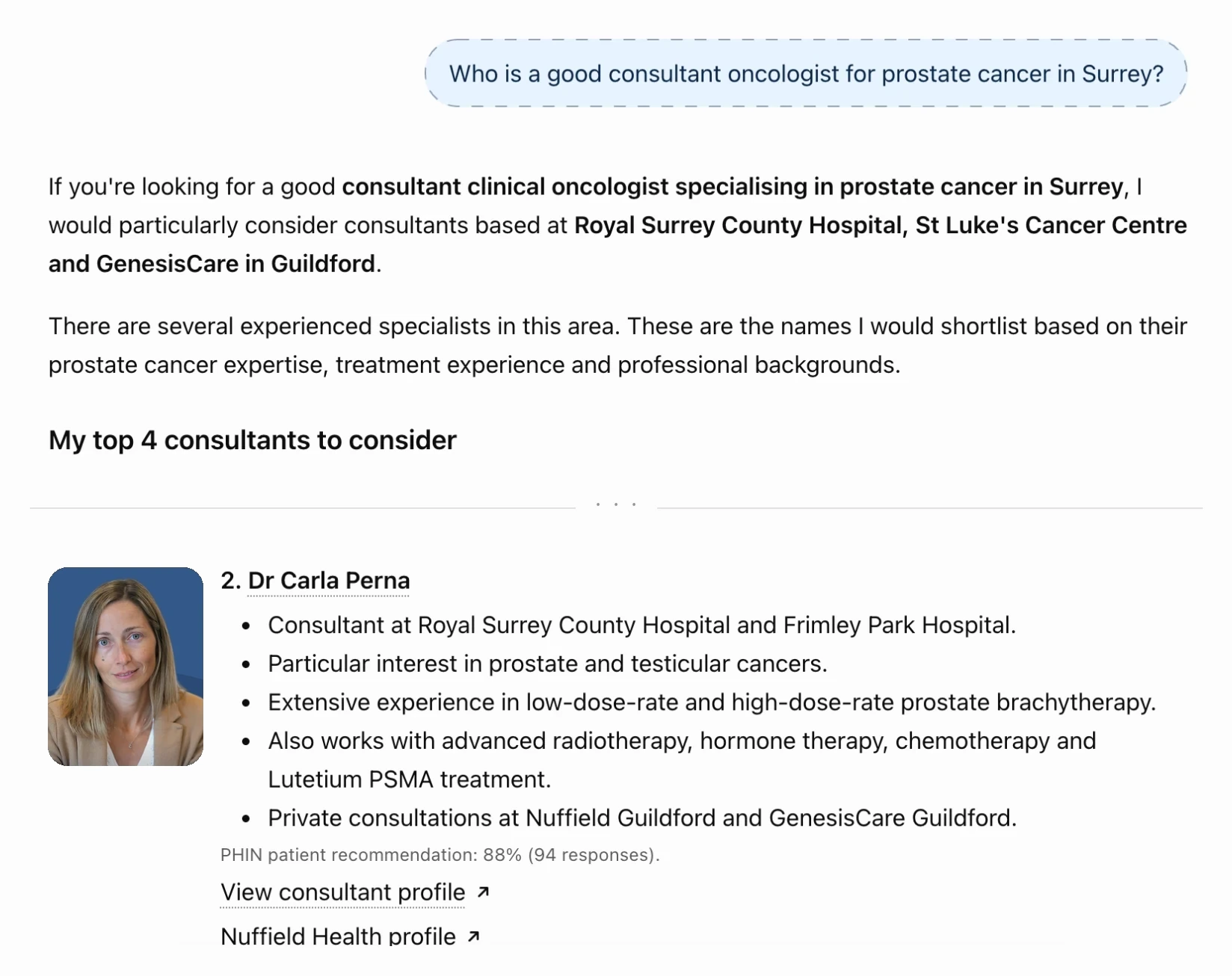
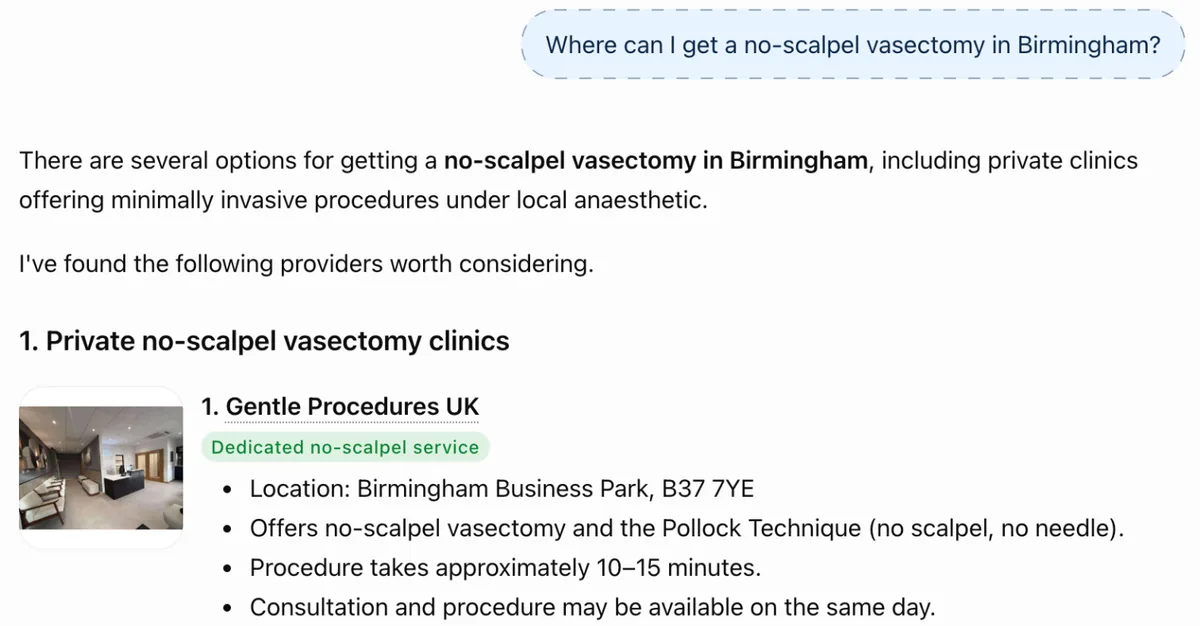
AI answers vary between runs, users, locations and dates, so the same question may give a different answer when you ask it. A screenshot shows what one answer said on one day. It is evidence that a clinic can be named, not a promise that it always will be.
Both started from nothing, and both followed the same pattern: one clear page per topic, named clinicians, consistent facts and steady review work. Citations are a visibility measure, not a count of patients, and these are results for those clients rather than a forecast for yours. All of our work, including the Harley Street Audiovestibular Clinic rebuild, is on our case studies page.
What this means for your clinic
Getting your clinic recommended by ChatGPT is mostly the unglamorous work of being clear, consistent and credible everywhere patients and machines look. If your self-test showed wrong facts, fix those first, because no amount of content will outweigh a wrong address. If the facts are right but you are still not named, the gap is usually proof from other sites: reviews, mentions and listings.
Be wary of anyone who sells a guaranteed ChatGPT ranking or a single file that will make assistants recommend you. Start with the self-test, keep a dated record of what assistants say, and judge progress over months rather than days. When you want a second opinion, request a free AI visibility check or read how our AI search optimisation service works.
Frequently asked questions
How do private clinics get named by ChatGPT?
ChatGPT tends to name clinics that are described clearly and consistently across the web. That means a website that says what you treat, where and how to book, listings that match it, genuine recent reviews and mentions on trusted third-party sites.
Your pages must also be open to OAI-SearchBot, the crawler behind ChatGPT search. Nobody can guarantee a mention, but these steps make your clinic easier to recommend.
How do healthcare providers get recommended by AI assistants?
The same foundations work across ChatGPT, Gemini, Perplexity and Google's AI Overviews: accurate listings, clear treatment pages with named clinicians, honest reviews and genuine coverage on other sites. Google says its AI features need no special markup beyond normal search eligibility.
Start by checking what each assistant says about you now, fix any wrong facts, then build proof on sites you do not control.
How do I get my clinic cited by ChatGPT?
A citation is a link ChatGPT shows next to its answer when it searches the web. To be cited, a page has to be reachable by OAI-SearchBot, answer the question directly near the top and be trustworthy enough to quote.
Pages with a clear first paragraph, a named clinician, a review date and facts that match your listings are the ones we see cited most in our clients' data.
How long does it take for ChatGPT to recommend my clinic?
There is no fixed timescale, and anyone who promises one is guessing. OpenAI says robots.txt changes take about 24 hours to affect ChatGPT search, but trust signals such as reviews and mentions build over months.
In our published case studies, Dr Carla Perna and Gentle Procedures UK had 162 and 67 AI citations recorded nine months after measurement began. Those are their results, not a forecast for yours.
Does blocking GPTBot stop ChatGPT recommending my clinic?
Not on its own. OpenAI uses GPTBot to crawl content that may be used to train its models, and a separate crawler, OAI-SearchBot, to show websites in ChatGPT search. OpenAI says sites that block OAI-SearchBot will not be shown in ChatGPT search answers.
If you want to appear in ChatGPT search, check that OAI-SearchBot is allowed in your robots.txt file.
Do reviews affect whether AI assistants recommend my clinic?
They appear to matter. Assistants answering local questions use the same public evidence patients do, and Google says positive, high-quality reviews can improve local visibility. Reviews must be genuine: under the Digital Markets, Competition and Consumers Act 2024, fake reviews and concealed incentivised reviews are banned.
Ask every patient in the same way, never write or buy reviews, and reply to the ones you receive.
How can I check if my clinic appears in ChatGPT recommendations?
Ask ChatGPT the questions a new patient would ask, such as which clinic to see for your treatment in your area, and note whether you are named and which sources it cites. Then ask about your clinic by name and check every fact. Repeat on different days, because answers vary.
Our free AI visibility check runs the same test across ChatGPT, Gemini, Perplexity and Google AI Overviews and writes up the results.
Can I write on my website that we are the top clinic so ChatGPT repeats it?
No. Under the CAP Code, objective claims need evidence you hold before you publish, and claims of being the top or leading clinic are hard to substantiate. A claim does not become acceptable because an AI tool repeats it, and it can mislead patients.
Describe what you do, who does it and what patients can expect, and let reviews and third-party coverage do the persuading.